Presswatch UK Week 1: Any excuse to talk about immigration
Exclusive research unpicks the trends in this weeks UK Media: We see a huge midweek pivot from the Epstein Scandal to Culture War nonsense!
In a week dominated by revelations and questions about wealth, power and accountability, the UK’s national newspapers found themselves returning again and again to a familiar theme: the stability of Keir Starmer’s leadership, the scandal surrounding Prince Andrew’s links to Jeffrey Epstein, and, by the end of the week, a sudden and coordinated shift toward immigration after comments by Britain’s richest man, Jim Ratcliffe.
At the start of the week, the press appeared to be engaged in unusually direct scrutiny of elite networks: the monarchy, senior Labour figures, and the internal machinery of government. Yet by Friday, the national conversation had noticeably pivoted. Immigration, sparked by Ratcliffe’s claim that Britain had been “colonised by migrants”, had surged to the forefront.
This first edition of Press Watch UK examines what appeared on the front pages of ten major UK daily newspapers between Monday 9 February and Friday 13 February 2026, identifying not just what stories appeared, but how frequently, and what that tells us about media priorities.
The Numbers: What Dominated the Front Pages
Across the 50 front pages analysed (10 papers × 5 days), clear patterns emerged...
Most frequent front-page topics
- Starmer leadership crisis: 24% of all front-page stories
- Epstein / Prince Andrew scandal: 22%
- Immigration: 10%
- Crime / terror: 8%
- Trans / gender issues: 6%
- Economics / business: 12%
- Other / human interest / international: 18%
In other words, nearly half of all front pages (46%) focused on either Starmer’s leadership or the Epstein-Andrew scandal alone. The chronology of this coverage is quite telling; Starmer's leadership was mainly spoken about from Monday to Wednesday. Thursday and Friday was dominated by immigration, and the story of gender identification in schools was particularly salient on Friday.
The rest of the agenda was split between economics and business (around 12%), immigration (10%), crime and terror (8%), and gender identity (6%), with the remaining 18% going to human‑interest and international stories. In the simplified tally you compiled, Labour crisis stories appear on roughly 88% of front pages at some point, Epstein/Andrew on 64%, crime on 26%, immigration on 22%, economy on 30%, and gender on 8%.
How different papers sold the week
Seen as a market, the national press behaved less like a simple “left–right” spectrum and more like a set of brands chasing overlapping but distinct segments of the same audience.
- The Sun, Daily Mail, Daily Express and Telegraph repeatedly returned to Epstein and Prince Andrew, with The Sun devoting about 80% of its front pages to Andrew/Epstein, the Mail 60%, and both the Express and Telegraph around 40%. Their headlines leaned on highly charged phrases such as “Lolita Express”, “cover‑up”, “royal bombshell”, and repeated references to “sex traffic” and “leaked” documents, with Rothemere, and Reach PLC's papers placing the emphasis on trying to get Starmer to resign.
- The Financial Times, Guardian, i and Metro focused heavily on Starmer’s survival, with around 80% of their fronts at some point carrying a “leadership crisis” frame, and the Telegraph straddling both markets by attacking Starmer while also amplifying the Andrew scandal.
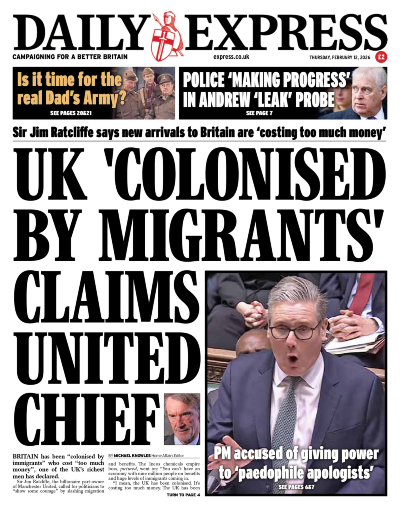
- Immigration barely featured until Thursday and Friday, when it suddenly appeared across the Daily Express, Telegraph, Times, Mirror and Metro, usually in reaction to Ratcliffe’s “colonised by migrants” line, sometimes reproduced almost verbatim in headlines, especially in the Daily Express.
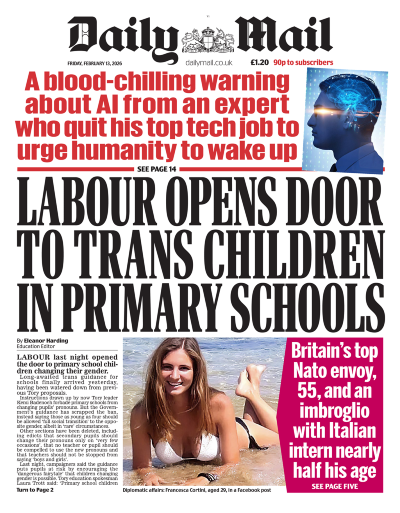
- Gender identity stories appeared only at the end of the week, with several titles running splash or prominent headlines about children “being allowed to change gender at school” or Labour “opening the door to trans children in primary schools”, classic culture‑war framing of what is, in policy terms, a complex safeguarding issue.
Messaging matters: The language UK papers used drove polarity of opinion.
Beginning with the furore around the Epstein Scandal, nearly all of the papers focused on the reputation of the monarchy rather than questioning what the Royals knew about Andrew and Epstein's relationship or what happened on Royal property.
Early in the week, several titles foregrounded precisely that angle. Across multiple fronts, such as the Mail, the Sun, and the Telegraph, their framing on Andrew stressed focus on him “leaking” envoy documents to Epstein, police “assessing emails”, and the palace signalling it would “work with police” or “support” a new probe. Rather than treating this as a systemic failure in how royals and ultra‑wealthy networks intersect with government, much of the coverage personalised and sensationalised it: the lone disgraced prince, the “royal bombshell”, the “cover‑up” that might “threaten the monarchy”. The system that enabled Epstein fades into the background; the spectacle of his connections becomes the product.
The sharpest demonstration of how the press behaves as a market comes later in the week with Jim Ratcliffe’s intervention. Ratcliffe, Britain’s richest man, told an interviewer that the UK had been “colonised by immigrants”, comments that quickly generated political backlash and an eventual mealy mouthed apology. Many newspapers also gave salience to Nigel Farage's Reform UK backing his statements, such as the Telegraph.
Two facts about Ratcliffe that are missing from this discourse. First, he is himself a migrant: he moved his tax residence to Monaco, a micro‑state where more than two‑thirds of residents are foreign‑born and recent census work shows over 75% of the population are non‑Monegasque. Second, detailed reporting has shown that this move was designed to save him up to £4 billion in UK tax. That is, a billionaire whose wealth is closely bound up with a decision to relocate to a low‑tax jurisdiction populated overwhelmingly by immigrants used the language of “colonisation” to describe other people’s migration to the UK.
The shift is clearest in some of the opinion writing that sits behind these front pages. Immigrant to the U.S, Richard Littlejohn’s Daily Mail column on the Ratcliffe row urges readers to “ignore the Left‑wing outrage” and insists that “millions agree” that parts of Britain have been “colonised” by migrants. He uses the "left vs right" divide to whip up a culture war; Ratcliffe, one of the wealthiest men in the country, is painted as a plain‑speaking outsider who has bravely said what “ordinary people” think. On the other side of the spectrum, the Mirror, owned by Reach PLC (The same ad the Daily Express), has one word in large letters on its front page: SHAMEFUL, playing into a left-wing angle on Ratcliffe's racist comments.
What is missing from all newspaper coverage, of course, is that net migration in 2025 was down to Pre-Brexit levels, at 204,000, and is on course to hit net-zero in 2026 according to the Office of National Statistics. Not only this, small boat numbers in January 2026 reached the lowest levels since Brexit, despite this January being the 5th hottest on record, showing how the problem is factually becoming a less news worthy issue.
Alongside this, gender identity in schools suddenly surfaces. Several titles run headlines claiming Labour is “opening the door” to trans children in primary schools or that pupils will be “allowed to change gender at school”, framed as a looming crisis rather than a discussion of pastoral care, safeguarding, or the real (and often limited) scope of proposed guidance. These stories occupy only a small slice of the week numerically (around 6–8% in your coding) but their timing is telling: they appear just as the Andrew/Epstein story could turn from personal scandal into a sustained conversation about the impunity of powerful men.
The blatantly obvious...
Taken together, the week’s front pages are best understood not as a clash between “left‑wing” and “right‑wing” outlets, but as the behaviour of a concentrated industry serving a small set of owners and advertisers. Some brands package their product as deference to the monarchy and hostility to migrants; others as forensic scrutiny of a Labour government; others as sober business analysis. But when the interests of wealth and power are in the frame, all face similar incentives.
In a week when human trafficking, sexual exploitation and alleged misuse of public office at the highest levels could have dominated the national conversation, the industry chose instead to move, by week’s end, back onto safer ground: migrants to blame, culture wars to fight, and the architects of the system safely out of frame.
 Jacob Barclay-Evans