Why many are reconsidering voting Reform UK in the Local Elections on May 7th
Thinking of voting for Reform UK in your council elections? Take a look at how they are currently getting on around the country!

In everyday conversations about politics in the UK, a familiar sentiment often emerges: frustration with the main parties. It’s not uncommon to hear people say that alternatives such as Reform UK “can’t be any worse” than Labour or the Conservatives. The appeal mainly lies in the prominence of Reform’s populist-nationalist leader, Nigel Farage, who presents himself as a strongman leader who will take a sledgehammer to the system.
Alongside national messaging on issues such as immigration, Reform UK has also made bold statements about how it would govern at a local level. After taking control of 12 councils in last years council elections, the party has had opportunities to translate its campaign promises into policy in several local authorities.
But how are Reform UK currently performing in power?
As Reform started to form cabinets in their majority controlled councils, they began trying to deliver on their promises.
Central among these were promises to cut council tax, eliminate what the party described as “waste and inefficiency”, taking inspiration from Elon Musk’s DOGE department, who resorted to shutting down Homelessness authorities and cutting 80% of USAID aids/HIV response initiatives.
At Kent County council, frequently described as Farage as a ‘shop window‘ into what a Reform government would look like, senior figures acknowledged that their efficiency drive had uncovered far less waste than expected. The council also proposed cutting transport services for SEND children, including Post-16 travel, despite limited financial savings.
A cabinet member admitted that assumptions about widespread inefficiency were “misplaced”, noting that previous administrations had already done this. After 15 years of austerity that has gutted councils, you’d think this was obvious! Therefore, despite pre-election commitments to reduce taxes, something other parties did not do, the council increased its taxes by 3.99%. This pattern has not been confined to Kent. Reporting indicates that all 12 Reform-led councils proposed increases at or near the maximum permitted level of 4.99% set by central government, despite earlier commitments to cut taxes.
Worcestershire County Council is perhaps in worst position of all. After failing to pass a budget, the Reform led council has to have a £59.9m bailout from central government, and raise council tax a whopping 9%. Nigel Farage since noted that he wish the party ‘never bothered‘ to campaign to take over the council.
Alongside these financial pressures, governance issues have also emerged. In Kent, a series of suspensions, expulsions and defections significantly reduced the number of Reform councillors within months of taking control. Five councillors were expelled in October 2025 alone, following earlier suspensions and internal disputes, while others left the party or joined breakaway groups. A leaked meeting, in which the council leadership was seen clashing with colleagues, further exposed internal tensions.
Kent County Councils Chaotic Leaked Meeting…
In Warwickshire County Council, instability has also been a defining feature. Council leader George Finch, who became the youngest council leader in the UK, faced a vote of no confidence less than a year into his tenure and survived by a single vote. Critics accused him of bringing the council into disrepute, while internal disputes led to three councillors departing or being suspended from the Reform group within a year of taking office.
More broadly, investigations by Byline Times found that at least 15 Reform councillors had been suspended, expelled, or had resigned within months of the 2025 elections, with several facing criminal investigations or controversies over racist or extremist content.
Can promising the same things produce different results?
Jump forward to May 2026, and Reform UK’s local election campaigns have, again, promised to cut “waste and inefficiency” in local government, despite previous failures, and national issues like “stop the boats”, which is adventurous considering most wards will be landlocked.
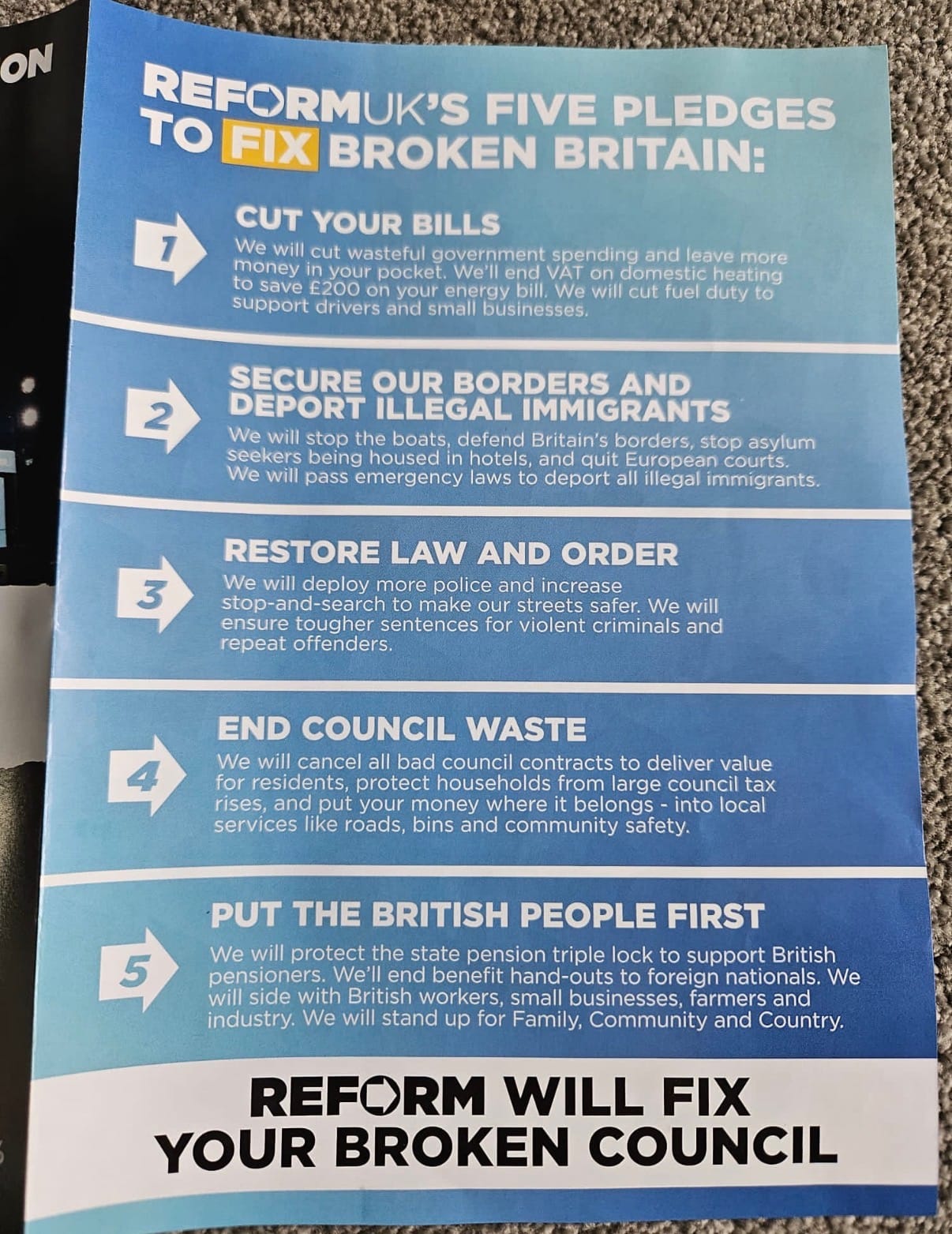
Similar to 2025, these messages are often presented in simple, direct language, designed to resonate with voters concerned about rising costs and perceived inefficiencies in public spending, but lack any detail of how they’d implement their solutions. This raises questions around if they actually have any targeted strategies to address local issues around the UK.
Another lesson Reform haven’t learned from 2025 is that their candidate vetting is too relaxed. One candidate is still under investigation for allegedly commenting he would “take the… limbs off” other candidates, while another has been suspended over his links to the BNP. Also, Manchester Evening News has seen posts including from a candidate who described an Orthodox Jewish community as a ‘demonic social structure’.
Your choice is clear
Reform don’t have any answers to your local area; they have no plan. This article has not attempted to argue for any particular party, nor has it sought to address Reform UK’s divisive national policies, but rather to examine what happens when campaign messaging meets the day-to-day responsibilities of running local services.
If you want to defend your local authorities from Reform UK, please head to the two tactical voting websites below, which tell you the best candidate option to defeat Reform UK in your ward!⬇️⬇️⬇️
 Jacob Barclay-Evans