
How Opinions Became the Enemy of Fact
“Everyone is entitled to their own opinions”, said the person who didn't want to admit they were factually wrong!
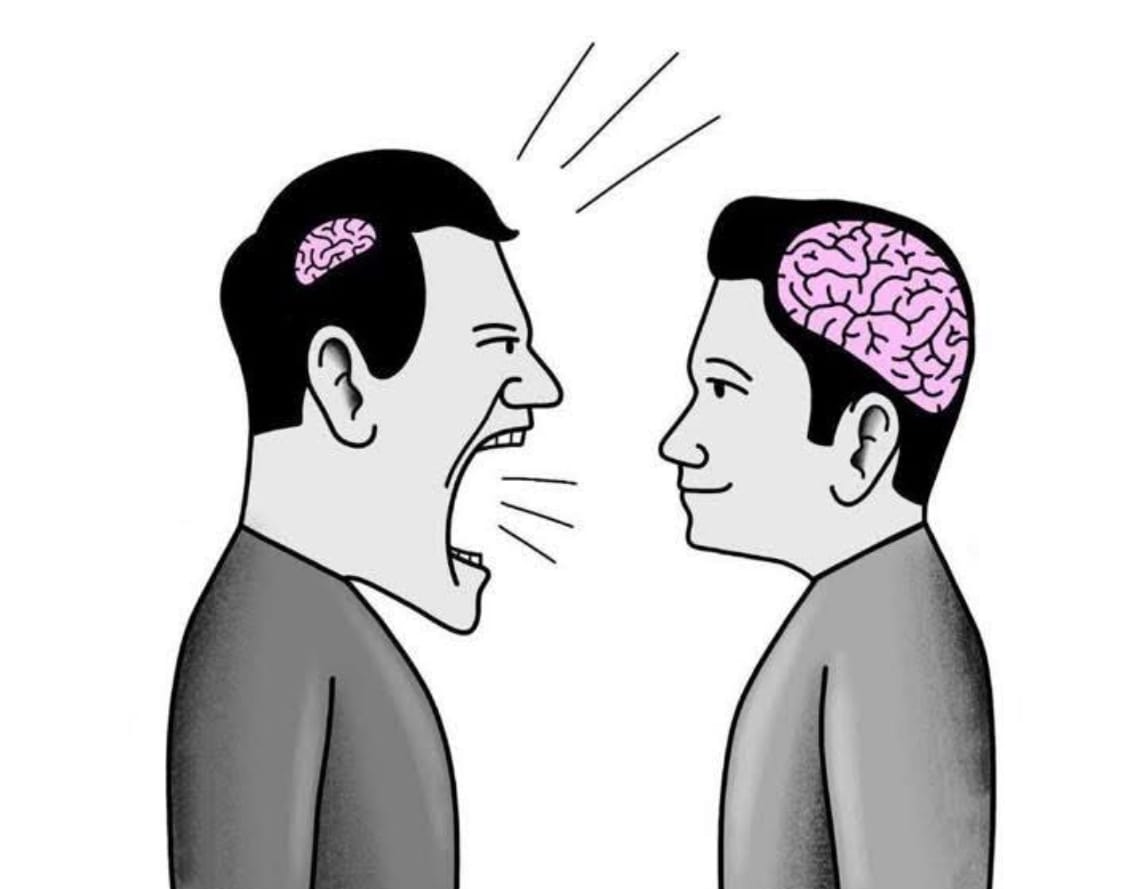
The most frustrating conversation is the one where the other person is utterly convinced they’re right, even as you watch them march confidently away from anything factual. We’ve all been there: the moment you present evidence, the whole thing collapses into the classic fallback “everyone’s entitled to their own opinion.” It’s a line that pretends all viewpoints carry equal weight, blurring the line between a narrative someone prefers and the facts sitting stubbornly in front of them.
More dangerously, because the UK have seem to lost the art of a good faith argument, partly due to the behaviour of the political class during the Brexit referendum and since, has turned our political landscape sour. A recent Ipsos poll shows that 85% of Britons believe the UK is deeply divided, with over half of the nation believing people with opposing views don't care about them, labelling said views "extreme".
But what is really a "fact"?
Before going any further, it’s worth clarifying what we actually mean by “facts”, because they are often misrepresented as rigid, eternal truths handed down from on high. They aren’t.
Facts are claims about the world that are supported by the best available evidence, tested against reality, and open to revision when better evidence emerges. This is not a weakness of facts but their greatest strength. Gravity didn’t stop being real because Newton was later refined by Einstein. The Earth didn't stop being spherical because people continued to believe the opposite was true. The sky is objectively blue. Germ theory didn’t collapse because we learned more about viruses. What changed was our understanding, not the underlying reality.
Confusing this process with opinion is where things begin to unravel. When people say “facts change all the time,” what they usually mean is that knowledge improves. Opinion, by contrast, does not improve; it either has merit in it, or it doesn't. Despite people claiming entitlement to their (incorrect) opinion, they cannot claim entitlement to their own facts!
Why facts no longer matter...
Populist-nationalist movements in the UK and across the globe are among the most immediate drivers of this decline. Their success depends not on evidence, but on emotional resonance, and facts are often inconvenient things when you’re offering simple answers to complex problems.
Populism thrives on breaking taboos. Not by revealing uncomfortable truths, but by confidently asserting falsehoods and daring institutions to object. When they do, the objection itself becomes proof of conspiracy. Reality is reframed as bias; expertise as elitism. Most notably, Kellyanne Conway’s now-infamous defence of “alternative facts” during the Trump administration wasn’t a slip of the tongue, it was a declaration of intent. Facts were no longer to be debated, tested, or refined, but replaced outright if they proved politically inconvenient.
The UK has hardly been immune. Nigel Farage has repeatedly leaned into rhetoric over reality, presenting emotionally satisfying narratives while brushing aside factual scrutiny as establishment sabotage. The point is rarely to win an argument on its merits, but to exhaust the very idea that merits matter at all.
Steve Bannon conspires building a multi-national populist-nationalist movement that denegrates the sovereignty of the UK, and abandons good faith politics, with Nigel Farage
On immigration, Farage has consistently relied on emotionally charged imagery and language to simplify a complex issue into a story of national crisis. His “Breaking Point” poster, which depicted a long line of refugees under the warning “the EU has failed us all”, was widely criticised for conflating refugees, migrants, and criminality, and for presenting a distorted picture of migration to the UK. When challenged, Farage defended the poster not with evidence, but by insisting it reflected a deeper “truth” that polite society refused to acknowledge. Official statistics that complicated this narrative, showing, for example, differing migration routes, legal statuses, or long-term economic impacts, were dismissed as establishment spin rather than engaged with on their merits.
His approach to climate change has been even more explicit in its rejection of evidence. Farage has repeatedly questioned whether climate change is primarily man-made, despite decades of scientific consensus. He has claimed that carbon dioxide should not be treated as a pollutant despite scientific consensus, dismissed net-zero targets as “lunacy”, and argued that UK climate action is pointless because Britain is “too small” to make any difference, a claim that ignores the cumulative nature of global climate action and the data on how climate action benefits the health of the UK population. These are not contested interpretations of data, but assertions that directly contradict established scientific findings.
When challenged, Farage does not counter this evidence with alternative research or credible expertise. Instead, he reframes climate science itself as ideology, casting scientists, civil servants, and international bodies as activists pursuing control rather than truth. In doing so, empirical findings are reduced to just another opinion, one that can be safely ignored if it conflicts with political instinct.
Across both immigration and climate change, the strategy is consistent. False or misleading claims are delivered with confidence, scrutiny is recast as bad faith, and institutions that produce evidence are portrayed as partisan enemies. The result is not simply disagreement, but a corrosion of the standards by which disagreement is meant to be resolved. What remains is a public discourse in which facts no longer arbitrate between competing claims.
However, populists didn't create these conditions; they just exploited them...
To pin this entirely on populists is too easy, and ultimately dishonest. Appeals to emotion over reason do not emerge in a vacuum. They flourish in hard times — when people feel economically insecure, politically ignored, and pessimistic about the future. In those moments, hope matters more than accuracy, and certainty is more comforting than complexity.
For much of the blame, we need to look beyond personalities and slogans, and towards the neoliberal consensus that has dominated Western politics for the past half-century. A political settlement that bound governments to financial markets, privatised essential services, and steadily hollowed out democratic control over the economy has left ordinary people with less power, fewer resources, and shrinking prospects. Real wages have stagnated, housing costs have soared, and the promise that hard work guarantees security has increasingly felt hollow.
The result is a peculiar catch-22. Radical reforms are desperately needed, yet any serious attempt at change is framed as reckless or even existentially dangerous. Politics becomes managerial rather than transformative, while the public is told there is no alternative but to endure. In this vacuum that needs to be filled with hope, simple answers and urgent narratives become irresistible.
Populists step in with precisely that clarity, offering narratives that make sense of complexity with a sense of righteous outrage. Their messages are amplified by a right-wing media ecosystem that has spent over a century riling the public and sowing division, legitimises their cause through institutional backing rather than needing evidence. Facts and nuanced debate become optional; anger, identity, and tribal loyalty do the heavy lifting. In such an environment, it is hardly surprising that evidence-based arguments struggle to compete. When the “responsible” answer is austerity, stagnation, or patience, people naturally gravitate toward voices promising immediate relief, even when those voices rest on falsehoods.
 Jacob Barclay-Evans
Read my political story below... you might relate!