
Reform UK’s PIP Plan will create a ‘Poverty Trap’ for disabled people
Reform UK plan to abolish PIP and put insurance cover costs onto businesses employing disabled people, claiming they will save £50bn in the process. But who will lose out due to this policy?
Reform UK’s welfare paper, Making Welfare Work, promises to save taxpayers £50 billion a year, partly by rebuilding Personal Independence Payment (PIP) around a simple idea: unconditional cash stays only for the most severe cases, while everyone else moves onto a UC adjacent, means-tested, council-run pot that only covers “verified additional costs.” It sounds targeted and carefully scoped. But Reform’s own numbers suggest the reality is far broader than the party is letting on.
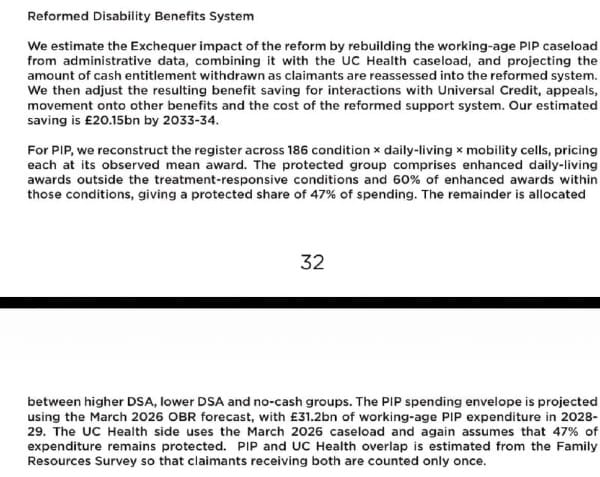
Underneath the rhetoric about "shirkers" and "trivial" claims sits a formula, and it's worth understanding it before anything else. Reform protects what it calls the most severe cases automatically: terminal illness, profound disability, and similar high-need categories. Beyond that, the party's own costing appendix defines "protected" as anyone currently receiving an enhanced-rate award, plus just 60% of enhanced awards inside those two categories.
Everyone else, including the majority of claimants who are on the lower standard rate of PIP, regardless of what their diagnosis actually is or their day-to-day impacts, is not guaranteed anything. The paper indicates that 2.89 million people will lose out on PIP, whereas the 'most severe' 2.16 million will keep theirs, meaning that up to 60% of claimants will have their support removed.
Two Main Categories are Under Fire
However, Reform’s paper singles out 'mental health' and 'musculoskeletal' conditions as the main two categories driving PIP’s growth, and earmarks them for the fastest, toughest reassessment measures.
The “Musculoskeletal” category is huge and loosely defined by the DWP, meaning It doesn’t just encompass bad backs and worn knees. According to DWP’s own condition list, it also covers rheumatoid arthritis, psoriatic arthritis and autoimmune and chronic pain conditions that flare unpredictably and can be every bit as disabling as anything sitting in the “protected” categories.
Reform’s paper does single out autism for special treatment, but only “severe autism with high support needs” is protected, think non-verbal autism, or autism alongside a significant learning disability. DWP doesn’t publish a breakdown of how many of the 225,000-plus autism claimants would actually clear that bar, but the National Autistic Society estimate that 25-35% of Autistic people are non-verbal or minimal verbal. That means a large share of autistic and ADHD claimants, most of whom are on standard rather than enhanced awards, are realistically exposed to losing cash support.
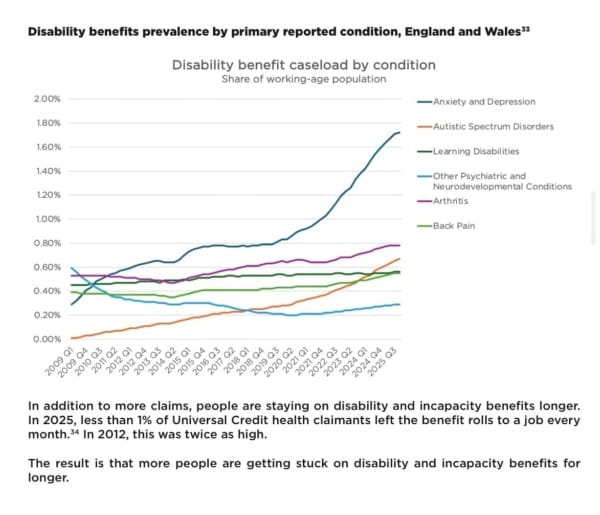
Overall, according to the latest official DWP figures, around 1.42 to 1.46 million PIP claimants have a mental health condition as their main disabling condition, and roughly 1.15 million have a musculoskeletal one, together making up about 69% of the 3.7 million people currently claiming PIP. Reform’s own costing appendix puts the number going through reassessment at 2.89 million people.
Who else could lose out?
Even if Reform were to remove benefits from ALL of these people, which is unlikely to ever happen for the reasons outlined above, that would still leave around 280,000-300,000 people who could potentially left out. Though we cannot say for certain what this figure would be, it is likely to be considerably higher than that, because it measures “people who keep the exact same cash amount” against “people reassessed”, not against “people who end up worse off overall.”
For instance, Reform’s paper introduces a new “Disability Needs Assessment” but never explains whether that fluctuating-conditions will be monitored over a period of time. Nor does it address how a single snapshot assessment is meant to capture something like lupus, MS or ME/CFS, a condition the DWP itself reclassified in 2024 from “musculoskeletal” into “neurological”, which shows even the department’s own categories struggle to pin these illnesses down consistently.
Under Reform UK's own methodology and subsequent formulas, the following conditions could also be subject to more intense scrutiny and potential loss of payment:
| Condition group | Example conditions | Approx. claims |
|---|---|---|
| Neurological | Epilepsy, MS, ME/CFS, headache disorders | ~230,000+ |
| Cardiovascular | Stroke-related disease, arrhythmias, heart failure | ~120,000+ |
| Respiratory | COPD, cystic fibrosis, bronchiectasis | ~100,000+ |
| Gastrointestinal/metabolic | IBD (Chrons and Colitis) , IBS, liver and pancreas disease, thyroid disease | ~30,000+ |
| Autoimmune/connective tissue | Lupus, “other autoimmune disease” | ~11,000+ |
| Renal/urological | Kidney disease, renal failure | ~19,000+ |
| Sensory impairment | Non-profound vision and hearing loss | ~25,000+ |
| Approx. total outside MH/MSK | ~521,000+ |
(Figures drawn from DWP's April 2025 PIP condition data. They're described as approximate because DWP only records one main condition per claimant, so the true totals, especially for people living with several conditions at once, are likely higher still.)
Therefore, standard-rate claimants, who make up the majority of the caseload, aren’t clearly protected in any category at all. Since protection is calculated by spending rather than headcount, and standard-rate awards are worth less per claim, the real number of individual people losing cash is very likely higher than the headline figures suggest. The document simply doesn’t publish enough detail to check this properly, which is a serious gap in a policy costed at £50 billion, or something purposefully done to shield true intent, as shown below.
An Employers Insurance Model that will create a 'Poverty Trap' for disabled people!
Reform’s other major idea, “Return to Work Cover”, copies a Dutch system in which employers must fund up to two years of an employee’s sick pay. Reform cites the positive Dutch headline (fewer disability benefit applications) but leaves out the colossal downsides.
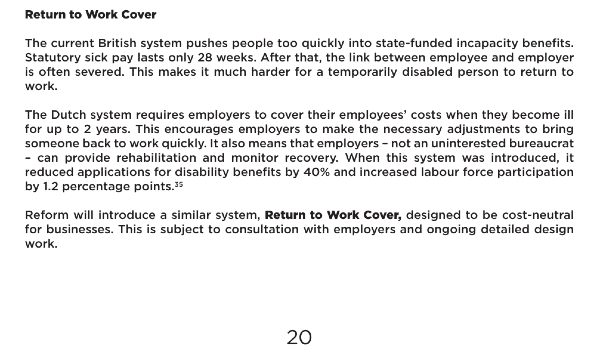
Dutch employment lawyers note that this wage continuation obligation has pushed many employers toward short, fixed-term contracts instead of permanent hires, specifically to avoid the two-year liability. A 2026 study of the Dutch system also found that making employers financially liable for sick pay had no measurable effect on how well they actually accommodated sick or disabled staff. It simply pushed firms to handle sick leave privately rather than through the public insurance scheme. None of this appears anywhere in Reform's paper.
Meanwhile, Reform has separately pledged to repeal the Equality Act 2010 on day one of government, the law that currently bans workplace disability discrimination and requires employers to make reasonable adjustments. Strip that protection away at the same moment employers become financially liable for two years of a disabled employee's sick pay, and you've removed the legal backstop against exactly the behaviour like hiring discrimination, or gradually managing out anyone seen as a higher health risk. Someone who loses their job that way, while also being reassessed off PIP's protected tier, could end up with neither an income nor a legal remedy.
Reform doners set to gain while claimants absorb the risk
Making employers buy compulsory insurance against staff sickness creates an entirely new market, and it's worth asking who is positioned to benefit from it. Arron Banks, a prominent Reform-aligned donor and self-described insurance businessman, has publicly pushed Reform to deregulate the insurance industry, including scrapping the Financial Conduct Authority. A new mandatory insurance product, sold into a newly deregulated market, is a significant opportunity for exactly the kind of firm Banks runs.
Farage: Five-Mil for me, and PIP cuts for thee...
Reform will undoubtedly use the 2.16 million people as reassurance to most people that they will not lose their PIP, and can do this due to their figurative framing. For claimants, the practical difference is stark; the prospect of a poverty trap for claimants who don't make the cut but also face unfair persecution from potential employers is real, and worth further scrutiny from policy experts. For many, this will be the difference between having money to live on and having none.
As for who carries the risk and who stands to gain: disabled claimants face losing income and, potentially, their jobs. Reform-linked insurance interests stand to gain a brand new compulsory market. Against this backdrop, the man leading the charge on welfare “fairness” is currently the subject of a Parliamentary standards investigation over an undeclared £5 million gift, a luxury those who he claims are swindling the welfare system will never see.
 Jacob Barclay-Evans
As with Welfare, Britain used to do Summer so much better. Find out how here: