The Commentariat Thinks Farage Is Finished. They're Wrong — Again
Reform UK boss, Nigel Farage, faces a parliamentary investigation into a £5m donation from Crypto-Billionaire. Here's why it means nothing!
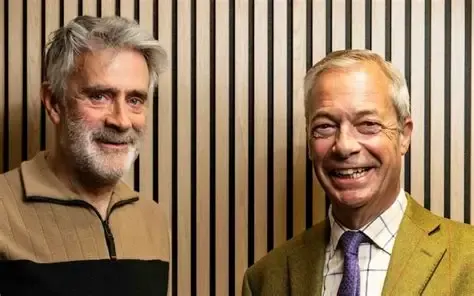
Nigel Farage will reclaim his status as the MP for Clacton-on-Sea when parliament reconvenes next week, following a by-election he called on himself, fought against novelty candidate Count Binface, to get ahead of scrutiny over an undeclared £5m donation from the Thailand-based crypto billionaire Christopher Harborne.
However, the investigation by the Parliamentary Commissioner for Standards is set to continue when parliament reconvenes, placing the Reform UK leader back at square one. If he is found to have broken the rules, he could yet be forced to fight a second by-election in his own constituency.
As ever, the British commentariat have followed Reform head-first into the circus tent, arguing that Farage has spent his summer pointlessly "arguing with a bin" and overstating the long-term damage to his party. The News Agents' Jon Sopel has repeatedly claimed Farage is making a mistake if he thinks he can apply Trumpian politics to the UK, and LBC's James Hansen has gone further, predicting Farage won't lead Reform UK in a year's time because he's grown prickly under scrutiny and is now fed up of politics.
And as ever, they continue to fall short of explaining why Reform led every single poll for well over a year right up until Andy Burnham became Prime Minister just over a month ago. In doing so, they misdiagnose Reform's problems and, more dangerously, play directly into Farage's hands.
The Situation in the Polls
It is true to say that Reform has shed a few percentage points in the polls over the summer, mainly due to Rupert Lowe's far-right Restore Britain gaining a small cultish following, while Labour are benefiting from the 'Burnham Bounce' since he assumed office, mainly at the expense of the Greens. Poll aggregators have Labour at a slight averaged lead of 26%, with Reform UK on 24%; however, some polling companies like YouGov still have Reform UK ahead of Labour by 1 point.
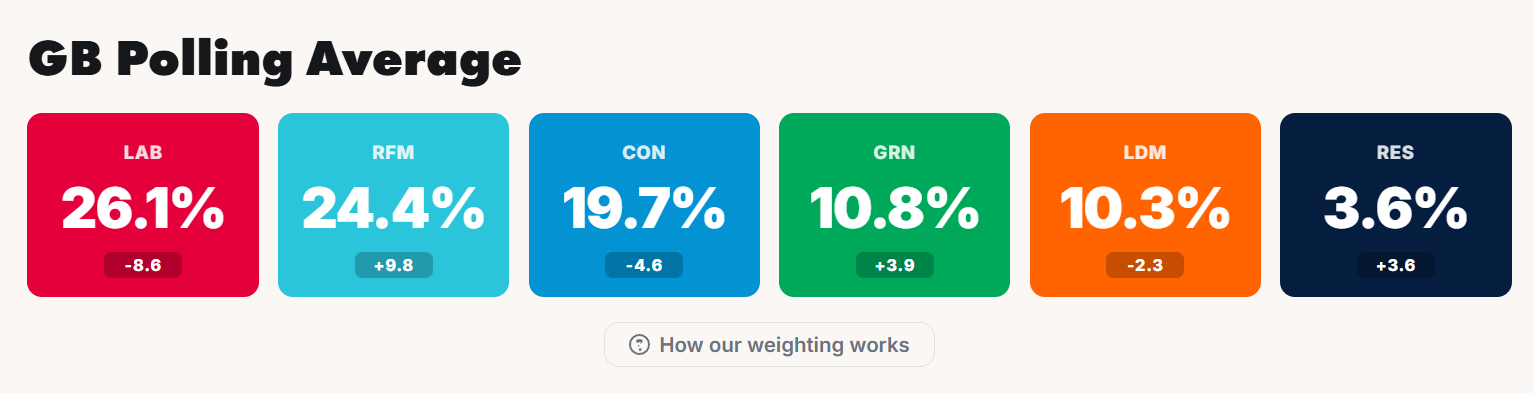
In the grand scheme of things, this is not a collapse in Reform's support because their floor has held strong, still above the Conservative Party who have stubbornly polled below 20%. If Labour are to truly tackle Reform UK, they need to rely on more than a parliamentary investigation into Farage's finances.
Why is Populism so important?
Strip away the caricature, populism in its simplest academic form is a thin-centred ideology that considers society to be separated into two homogeneous and antagonistic groups, 'the pure people' versus 'the corrupt elite' (Mudde, 2004). In this sense, it doesn't need a fully worked-out policy programme to function because it is based on opportunism and opposing political and cultural scapegoats.
Make no mistake, establishment politicians are to blame for the rise of Reform UK. Populism generally gains salience because the majority of a populace are struggling in their day-to-day lives and not benefitting from the status quo, leaving them disenfranchised by mainstream politics and searching out alternative answers. Right-wing populism steps in to provides those answers as scapegoats: mainstream politicians, the media, the civil service, the courts, and social minorities like immigrants, LGBTQ+, ethnic groups.
Farage's party leverages this for political capital, the same way Donald Trump's movement does in the US, and the way they do it can be broken down into three main steps:
Populism emerges in times and places of hardship
Farage's victory came in Clacton-on-Sea, a constituency where Farage has never held a single in-person constituency surgery, and where he has faced repeated criticism for prioritising trips to the US over local casework.
None of that mattered to a majority of voters (62%).
It's no coincidence that Reform's 2024 intake, and their victories in May's local elections, sits overwhelmingly in dilapidated seaside and post-industrial towns - older demographics, low-immigration, high-inequality places that have watched investment and opportunity drain away for generations. Jaywick for instance, is an area in Clacton that is consistently cited as the most deprived area in the UK due to chronic unemployment, underinvestment leading to many people living in converted static caravans, and rampant poverty.
Trump built his coalition on the same geographical strategy with the same grievances, turning the cost-of-living squeeze under Biden into a referendum on who was to blame, and campaigning on issues like the 'invasion of illegal immigrants'. Just days after winning Clacton, Reform UK unveiled a policy to deploy the Royal Navy to intercept small boats in the Channel and physically return them to France - a plan French authorities immediately called a breach of maritime and international law. This shows that tokenistic opportunism can be effective for populists in times of hardship, as it continues to be for the AfD in former East Germany, and for the National Rally in France's high poverty areas.
Watch Clacton voters justify their vote for Nigel Farage
Desperation also drives a cult of personality
Despite facing only a joke candidate as serious opposition, turnout held up reasonably well for a by-election, and Farage won by a landslide: 22,239 votes to Count Binface's 9,455. The people of Clacton clearly like the man, and would likely return him again if necessary.
Because populism has an antagonistic villain, Farage paints himself as the "strongman" hero figure who will do what 'the people' want, taking a knife to the very establishment he owes his status to. Despite going to one of the most expensive private schools in the UK in Dulwich College, having a lucrative career as a banker, orchestrating Brexit, and being an elected MEP for near 30 years, Farage plays on being a disruptive outsider, which is seductive for disenfranchised voters looking for an identity that empowers them. When Farage triggered the Clacton by-election, he framed it explicitly as people versus elite, telling voters the contest was to give them power rather than parliament.
Similarly, Trump has spent a decade selling himself as an outsider despite being a billionaire and a fixture of American public life for forty years, deploying nationalist language and directing blame toward political and cultural elites. A compelling example was when he was accused of avoiding taxes during a televised debate between him and Hillary Clinton; he admitted it, but said it only happens because of corrupt politicians like Clinton. The honesty in that moment fed into his narrative that establishment politicians are all the same so they need him to take a hammer to the state. Fast forward to 2024, despite being indicted on 34 felony charges, being found civilly liable for rape, and various corruption scandals, Trump was re-elected.
The Victim Mentality
Because people are struggling, and their identities are grounded in populist tropes, actors like Trump and Farage can bypass issues that would normally bring down an esteemed politician. Because their supporters' identities are bound up with the leader, cognitive dissonance entrenches their views when confronted with information that damages their leaders' reputation. This often leads to the supporter trying to discredit the claim as an establishment smear, or failing that, they will align their view with the populist's actions to justify their continued support.
Throughout his time in American politics, Trump has repeatedly claimed to be the victim of establishment attacks, using claims of 'fake news' to remove oval office passes from the press, claimed that the 2020 election was 'stolen', which insighted an insurrection on January 6th 2021, and is currently getting ahead of the November mid-term elections to justify cracking down on democracy when he loses due to only maintaining a majoritarian (34%) approval rating amongst cultist supporters.
In this clip, a lady says she would not support Trump if he 'perved on teenagers'; when presented with the evidence she claimed it was AI; when that was disproven, she defended Trump's actions.
When announcing the by-election Farage has repeatedly described himself as one of the most attacked politicians of modern times, a claim that provoked fierce pushback from critics who pointed out that Labour MP Jo Cox and Tory MP David Amess were both murdered. He claimed that the coverage of the dodgy donation was all an 'establishment smear' against him and that the media had came to one of his properties to ask him questions, something that is standard practice for news outlets. This recasts Farage as a victim being persecuted by media and establishment parties alike, invalidating any criticism of his actions.
The stark reality...
While British journalists may be musing over the idea that Farage is in a vulnerable position politically, the reality is that he will employ these tactics to take back control of the media narrative, and use the Clacton by-election to claim that 'the people' have already spoken on his financial scandals.
Reform UK's leader will not be the only one under further scrutiny when Parliament returns. Andy Burnham rose to power and has governed throughout the summer hiatus, meaning that his big-ticket policies are yet to be announced or scrutinised by parliament. Hence, the Labour Party must be wary of said 'bounce' in the polls, and realise that it will only hold up if they understand why Reform UK are snapping at their heels in the first place.
 Jacob Barclay-Evans