John Healey's conference speech spells danger for Labour
As John Healey delivers his first speech at Labour Party conference as the Chancellor of the Exchequer, the UK are left wondering how his treasury will deliver different results to Rachel Reeves.
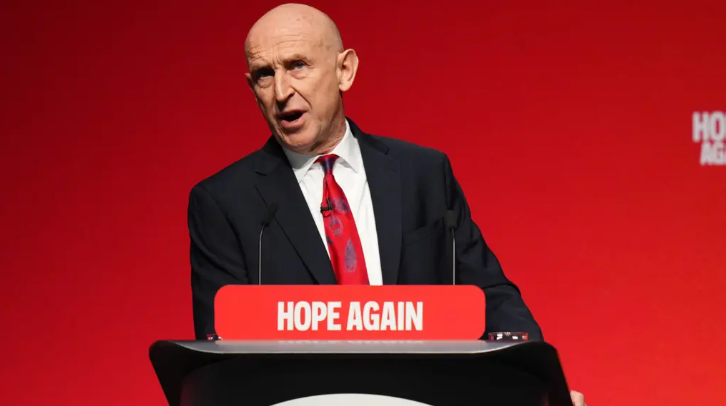
There is a different feeling at Labour conference this year. Walking the halls, you notice a bigger union presence, more lay members who have come to be part of it rather than to be managed, and, most noticeably, more smiles. Since Andy Burnham became Prime Minister, the mood among the party faithful has visibly lifted. "Hope again" is the slogan of the week, and for the first time in a while it feels like something delegates believe rather than something they have been told to repeat.
When the Chancellor stood up to speak, John Healey wove that theme through the whole speech. He delivered it with a smile and a confidence we haven't seen from a chancellor since one of his idols, Gordon Brown, was in Number 11. Healey wants the party to believe the country can hope again, and in the room, at least, they did.
Watch the Chancellor's speech in full here
The speech leaned heavily on trade unionism, and Healey came close to romanticising it. He spoke of the miner's lamp on the shelf at his home in Rotherham, a reminder of Cortonwood colliery, where Thatcher's crusade against mining communities began. The last pit in his area closed in 1994, when one in three people were out of work. His answer back then, he said, was "jobs, jobs, jobs". Now, he argued, it is "good jobs, good work, Britain working again", to which, he tied to a lineage that ran from the Jarrow marchers to Attlee's path to full employment.
The big announcement came with the rebuilding of the Union Learning Fund, first brought in by the Blair government. Delegates rose to their feet. The TUC said it would widen access to training for workers up and down the country, particularly those who need it most, and it has been welcomed by employers, training providers and unions alike. It was the moment of the speech, and Healey knew it.
From there he turned his fire on the opposition. The Tories got the expected battering, and Reform's Nigel Farage was described as "Liz Truss with a Bitcoin account". Perhaps more notably, the Chancellor left the Green Party alone, unlike Starmer and Reeves, perhaps suggesting that his union-idolising rhetoric is an attempt for the party to appeal to its left flank once more.
Then, having lifted the room, he turned to what he called the core of the budget: fiscal discipline. That is where the speech began to come apart.
Healey did have a reindustrialisation story to tell. He spoke of industry building nuclear reactors and putting Britain at the heart of energy, of Rolls-Royce investing £300m in new factories, and of £6bn committed to shipyards to dock the submarines that defend the country. The GMB, he said, helped get that deal over the line, and trade unionists are "full partners" in the project. There is something real here, and putting unions at the centre of industrial strategy is a welcome change of approach.
But look at where the speech went next. The budget, he said, would give families and businesses "a bit of breathing space". Additionally, the flagship idea for the next generation was teaching young people the value of work: turning up on time, getting on with others, respecting people with more experience, and the pride of the first pay packet, drawn from his own first job in a pub. He promised a local apprenticeship service, run through devolved authorities and paid for by DWP savings, and said benefits should be a bridge to work rather than a trap. He spoke about emerging sectors and harnessing AI rather than being outrun by it. And he offered the line that summed up the whole approach: "we need to grow the pie rather than to distribute it differently", and that "you can't fund the ends without the means".
That is the language of post-Thatcher Treasury orthodoxy, where Labour governments have seen their role as to merely modernise neoliberalism, and provide relief to the struggling, which inevitably subsidises the profits of rentier capital that thrives when workers have little spending power. Strip away the miner's lamp and what remains is a familiar position: we would love to do something structural, but there is no money, so the best we can do is offer some relief to struggling families while the market carries on as before.
For instance, his reminiscing about the first job, 40 years ago, also skirts the real problem. Nobody doubts that young people have a work ethic. A work ethic does not get anyone onto the housing ladder, out of their parents' spare room or precarious accommodation, and it does not make a family of two or three children affordable. Those are the promises the social contract used to keep, and it is broken. Healey talks about "good growth" and "good jobs", and it is right that we need more of both. But he offered no account of how a job becomes a good job, nor of how work is going to give people the security it once did. Growth, he said, is not just a graph but a family finally getting a holiday and a high street where the pubs stay open. Fine, but nothing in the speech explained how that gets delivered.
The result was a lukewarm speech and a hollow one, despite the bouncing optimism in the crowd. But hope needs something to attach itself to, and on the structural problems that define working people's lives, the Chancellor has offered little. Wrapped in the language of fiscal discipline, this is more of the same orthodoxy, delivered by a chancellor who, for all his charm, seems to lack the ideas to meet the challenges of the day. More must come out of his October budget and when the prime minister sets out his '10 year plan' for the nation; for Labour, it is radical or bust.
 Jacob Barclay-Evans