Why the UK's 'electoral democracy' is an illusion
Heading to the ballot box every year is an illusion we all take part in, knowing that nothing will ever change in our so-called 'democracy'.

Parliament may be 'sovereign' in name; many of us may go to the ballot box every few years for a general election; we may have our right to lose when purchasing our weekly shop; we may have our right to get on our soapbox about the government in front of the house of commons. While this appears a 'free' nation, this does not necessarily mean that British society actually functions as a democracy.
The word itself is derived from the ancient Greek saying 'demos-kratos', meaning 'the power of the people'. Thus, democratic systems should seek to represent the masses so as to generate the outcomes they want for society. Political theorists have thereby determined that the nucleus of a democracy should be 'free and fair elections' of representatives, dubbed an 'electoral democracy' by the V-Dem institute.
The UK is, in fact, deemed an electoral democracy by the V-Dem institute, scoring 0.833/1 in 2026 (above the global average of 0.489/1), which determines it's status on the following factors:
- Elections are free, fair, and reccurring.
- Elected officials actually hold political power.
- Suffrage is universal
- Parties and candidates can form and compete freely.
- There's a reasonably level playing field, including freedom of speech, media and civil society.
On the surface, this all seems in order. The issue is that V-Dem's methodologies do not take into account many of the structural issues of that of British 'democracy'.
For instance, Elected officials 'actually holding power' is used to determine whether representatives are merely a mouthpiece for a dictatorial regime or not. However, this does not take into account how the UK has privatised its economic power under a neoliberal model, leading to a continuous spiral of austerity measures and simultaneous restrictions on the government's ability to make bold political decisions that solve any of these structural issues for its citizens while wealth inequality soars for vested interests.
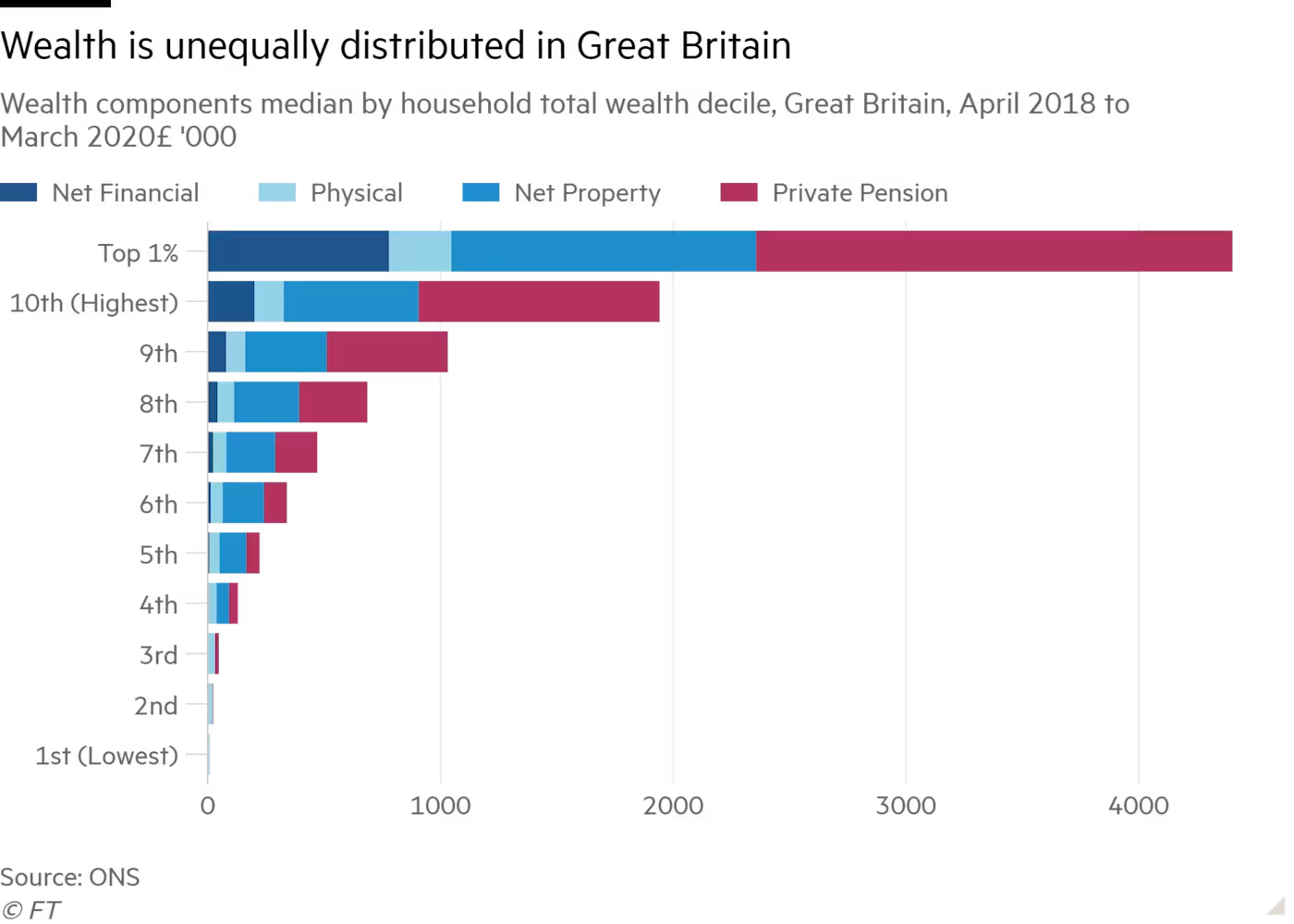
Gordon Brown first imposed fiscal rules on his own treasury and granted the Bank of England independence as Chancellor in 1997 to prove to investors that the Labour Party could be trusted with the economy, something that has stuck ever since. Following 2008, George Osbourne furthered this sentiment by introducing the Office for Budget Responsibility in 2010 to scrutinise a chancellor's economic decisions; since then, bond markets have been heavily reactive to OBR reports, whose pro-austerity methodologies have remained largely untouched.
The result has been a diminishing the role of a sovereign parliament in delivering conditions for the British population to thrive.
This is not demos-kratos.
V-Dem also uses the idea of both parties and the media being able to 'compete freely [...] on a level playing field' with one another is just as ludicrous. Once again, their methodology is geared towards judging whether parties can operate without state bans, harassment or whether the opposition is state sponsored.
Unfortunately, they do not account for the fact that Western electoral democracies like the UK can be easily tainted through political donations to parties and individuals by vested interests who use their wealth to leverage lobbying power in times of rampant inequality.
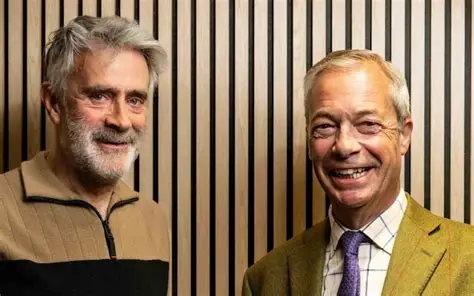
Right-wing populist party, Reform UK, received two £36m donations in the space of 24 hours from separate crypto-billionaires, the largest donations in British political history and equal to three-quarters of all parties' 2024 general election spending combined. This followed an undeclared £5m gift from one of the doners, Christopher Harborne, to Nigel Farage personally. Is it just a coincidence that Reform UK published a policy to deregulate the Crypto industry shortly after?
While this is an extreme example, other parties have also had money pumped into their coffers, such as Lord John Sainsbury's £10m donation to the Conservative Party, in 2022 Lord David Sainsbury's £8m donation to the Liberal Democrats in 2019, and a Cayman Islands-registered Hedge Fund Quadature Capital LTD's £4m donation to the Labour party in 2024. Personal donations also plague UK politics; as an example, before the 2024 general election, the incoming Health Secretary, Wes Streeting, received large swathes of donations from associates of private healthcare.
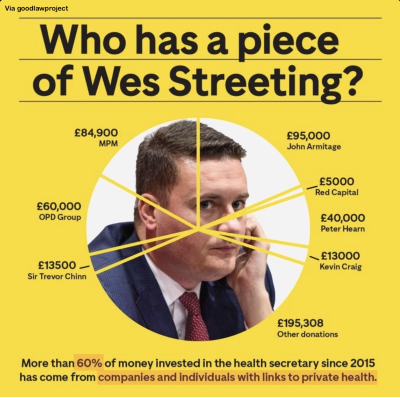
Factoring in all of this, this shows that the UK's public financing is in a dire position, where parliament can be a vehicle for money to be worth more than the vote of a constituent.
This is not demos-kratos.
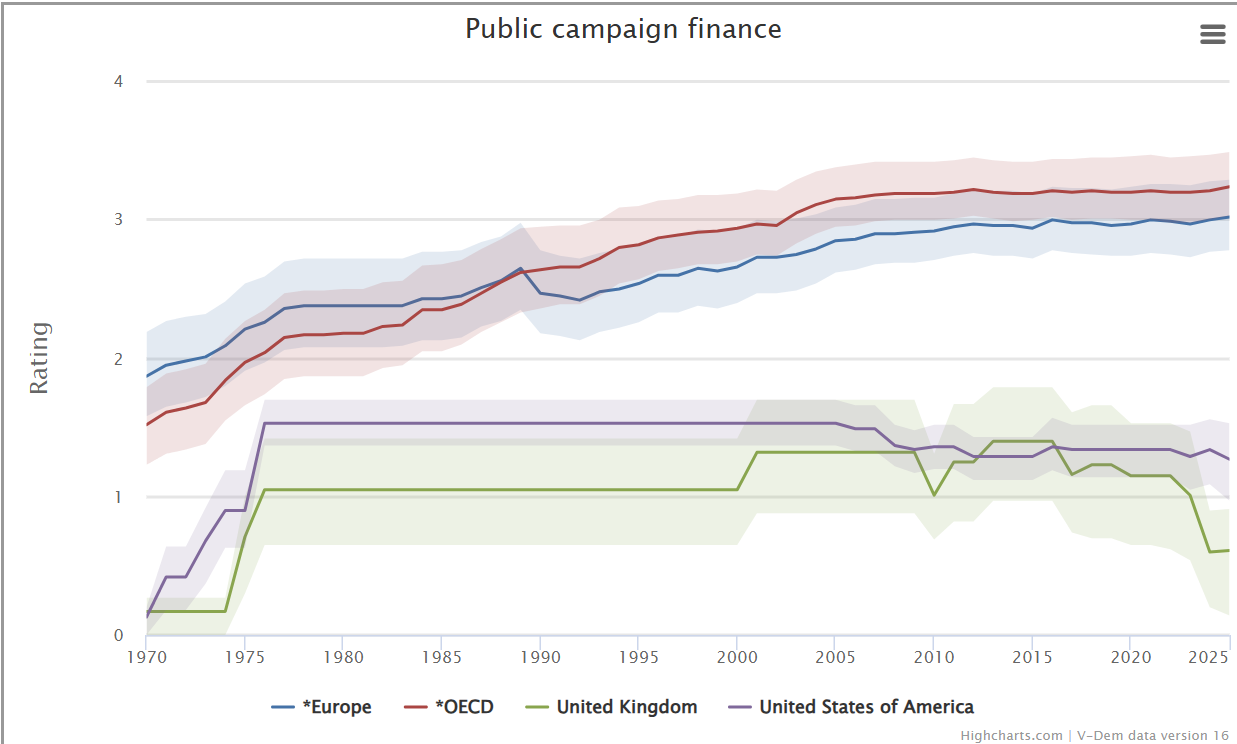
Not only this, but the 'free press' in the UK is also captured by vested interests; 90% of the UK's national newspapers are owned by 3 companies: Reach PLC, Daily Mail Group Media (owned by Lord Rothemere), and News UK (owned by Rupert Murdoch). These newspaper tycoons have a long history of promoting politics that suits their own interests, dating back to when both Lord Beaverbrook and Lord Rothemere admitted to using his newspapers for political campaigns rather than for commercial profit, often promoting the Nazi's and Oswold Moseley's British Union of Fascists throughout the 1930's.
This is not demos-kratos.
Compounding the issues of a lack of parliamentary sovereignty and how lobbying power can cost more than the vote of a nation state essentially renders the 'universal suffrage' indicator futile. This is corroborated by the nation's disenfranchisement with democracy, with over half of citizens dissatisfied with politics. The 2024 general election received a mere 59.7% turnout, 7.6% lower than in 2019. Even then, the UK's first past the voting system reinforces a two-party system, where the Labour Party can receive 33.7% of the vote in 2024 and win a landslide majority, meaning that because turnout was so low, only 14% of the entire British population voted for their government.
This is not demos-kratos.
However, the Brexit referendum, a form of direct democracy - where 'the people' get to vote on policy rather than representatives, received a 72% turnout. While said same vested interests were heavily pro-Brexit, and undoubtedly had an impact on the overall decision, this also reflects what political intellectuals often fail to realise. Regardless of the aftermath, people voted in that referendum because they felt that, for a small moment, they had the power of demos-kratos.
Mainstream politicians must now recognise the immediacy of turning the UK into a real electoral democracy. Prime Minister, Andy Burnham, is missing the mark by proposing a £500,000 limit on political donations, while estimates show that running politics through general taxation should cost around £150-200m per annum. Burnham has also long been an advocate of electoral proportional representation and reform of the House of Lords; delivery will depend upon if he chooses to cave in to the anti-democratic nature of the British machinery.
 Jacob Barclay-Evans